My son’s friend, Camron, was looking to buy a pull-behind camper he’d found online out near the South Carolina/ Tennessee Border. His dad couldn’t make the trip, so he asked me to tag along and help him inspect it. It was only a few hours away, so I figured we’d be back by dinner. I was wrong.
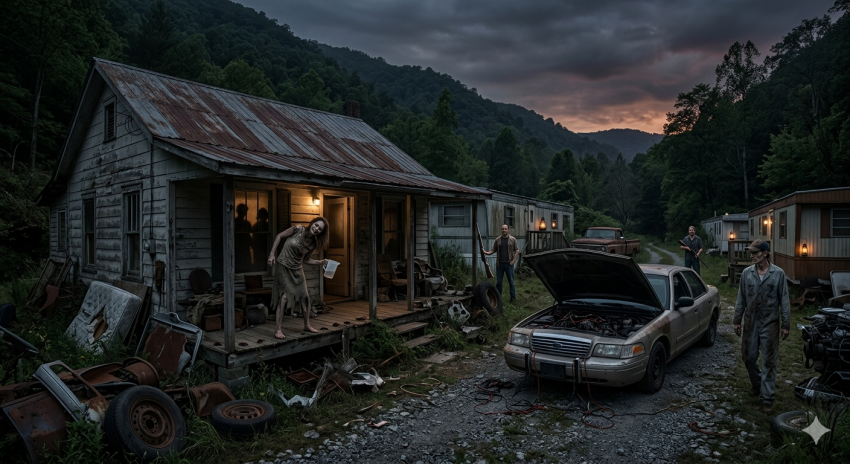
We followed the GPS down a winding gravel road that dipped into a deep, jagged holler. The transition was immediate. The nice atmosphere vanished, replaced by a landscape of rusted machinery and collapsing trailers. It was a “drug city” vibe—the kind of place where you feel the weight of eyes on you from behind every boarded-up window.
We pulled up to the address, a rundown house surrounded by overgrown weeds and piles of scrap metal. We knocked, but at first, the silence was absolute. No one answered. Then, as we turned to leave, Camron’s car gave a pathetic, hollow click when he turned the key. The engine was dead. To make matters worse, I pulled out my phone to find the signal had completely vanished.
That’s when I felt that prickle on the back of my neck. I looked toward the woods and the surrounding trailers. People were emerging from the shadows, just standing there, unblinking. Some were leaned against porch railings, casually holding shotguns and rifles, watching us like we were prey that had walked right into a snare. I caught movement in the darkened windows of the main house—silhouettes shifting, watching our every move as if they were waiting for a signal to move in. It felt like a robbery setup, or something much worse.
The front door creaked open. A woman stepped out, barely dressed and looking like she’d been awake for a week. Her skin was pale and just unhealthy looking, her eyes were wide and sunken. She didn’t ask why we were there; she just stared with a jagged, unsettling smile.
“The camper paperwork is inside,” she rasped, her voice sounding like gravel. “But you boys look thirsty. Come inside. I’ve got some water. Come inside and we can talk.”
The hair on my arms stood up. There was something “off” about her posture, her torso twisted at an angle that looked physically painful. “No thanks,” I said, my voice cracking. “We’ll just stay out here and try to get the car started.”
Her smile didn’t fade, but her eyes darkened. “It’s hot out here. Much cooler inside. Just come in for a minute.”
Every time we refused, her movements became more erratic. She started pacing the porch, her voice rising in pitch. “Why won’t you come in? I’m being neighborly! Just get in this house!” The more we insisted on staying in the open, the madder she got, her face turning into pure rage.
As she grew more agitated, then a man emerged from the shadows. He claimed to be a mechanic, but he looked like a specimen that had crawled out from under a rock. He didn’t say a word to us; he just exchanged a long, silent look with the woman—a look that confirmed this was a coordinated trap.
He began “fixing” the car, but his movements were nonsensical. He ripped out wires and disconnected components with trembling fingers. After ten minutes of making the engine look like a crime scene, he muttered, “I’ll be right back,” and vanished toward his trailer.
He never returned. A teenager eventually wandered over and told us the “mechanic” had fallen asleep on his couch—apparently, he’d been on a week-long bender and couldn’t be woken up.
The sun dipped below the ridge, and the shadows from the trees began to bleed toward us. The air turned freezing. My patience finally snapped under the weight of the fear. “SOMEBODY LET ME USE A PHONE OR I’M WALKING OUT OF HERE TO CALL THE LAW!” I roared.
The reaction was chilling. The people who had been watching from a distance stepped forward, and more guns appeared from the surrounding trailers. One older man finally led us to his trailer to use a landline. The stench hit me like a physical blow—it smelled of rotting trash and wet, dead animals. Roaches literally carpeted the walls, scurrying in the dim light of a flickering bulb. It seemed safe enough so we waited there.
It was 11:00 PM by the time Camron’s dad finally arrived to rescue us. As we towed the car out of that holler, I looked back at the house. The woman was still standing on the porch, a dark silhouette in the moonlight, watching us leave. I realized then that the camper probably never existed—it was just the bait.
To the woman in the holler and her “mechanic” partner: Let’s not meet again.