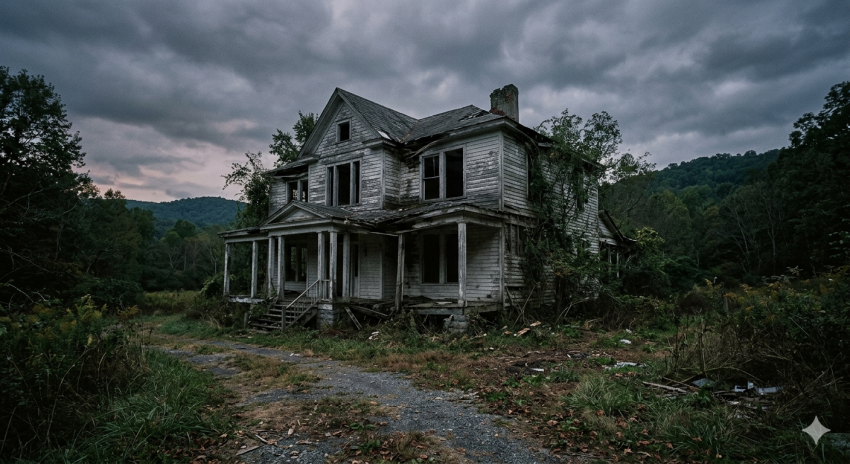
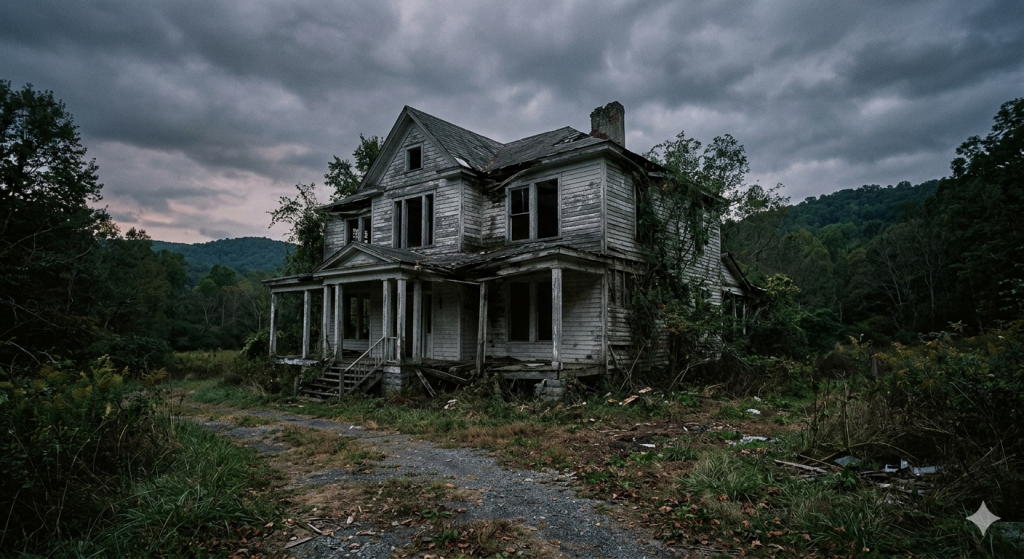
The old family home in Pulaski, Virginia, is a skeleton of its former self now a sprawling, silver-grey ruin that the mother nature is slowly trying to drag back into the earth. To look at it today, you’d think it was a place that never wanted to be lived in, but back when my grandparents lived there, it was a grand, spacious thing. It was the kind of house that could swallow twenty people for a holiday weekend and still have room to breathe. During the humid Virginia afternoons, it felt peaceful, bathed in that golden, sleepy light. But as the shadows stretched long across the floorboards, the house began to feel less like a sanctuary.
I spent my middle school years in one of the upstairs bedrooms. It was a drafty space, positioned right at the edge of a long, narrow hallway that felt unnervingly dim, even at noon. There was only one window at the far end by the stairs, leaving the middle of the passage in a permanent, dusty twilight. When my parents were home, the house felt solid. When they were working late, however, the air upstairs seemed to thicken. I’d be sitting on my rug, arranging toys or watching a flickering TV screen, when I’d feel that prickle on the back of my neck—the distinct, heavy sensation of a pair of eyes fixed on me from the hallway.
Then, there were the doors. I liked the sharp, metallic click of a latch seating into the frame. I always made sure it was shut. Yet, I’d watch as my bedroom door would slowly, deliberately groan open. It wasn’t the swing of a breeze; it was a steady, pressured push. I’d call out for my mother, expecting her face to pop around the corner with a smile, but I’d only be met by the silence of that dark hallway and the smell of old wood.
The most vivid encounter, the one that still makes the hair on my arms stand up, happened on a blindingly bright summer day. The house was quiet—Grandpa was out, and Grandma was napping deeply in the back wing. I was wandering through the house with Mickey, our Australian Shepherd mix, padding along at my heels. I had a craving for something cold, so we headed toward the laundry room just past the kitchen, where the big chest freezer hummed.
I popped the heavy lid, the cold mist swirling out into the humid air. I looked down at Mickey, who was watching me with expectant eyes, and joked, “What flavor do you want?”
The words hadn’t even fully left my lips when a voice—distinct, dry, and entirely unfamiliar—parroted me from the empty kitchen.
“What flavor do you want?”
It wasn’t just a repeat; it was a mimicry, delivered with a sharp, mocking cadence that felt like a cold finger tracing my spine. I froze, thinking maybe my step-dad had snuck home early to prank me. I ran into the kitchen, then the living room, then checked the porch. Nothing. The house was a tomb, except for the ticking of the grandfather clock and Mickey’s confused whining.
It wasn’t until years later, long after we’d moved away and the Pulaski house had begun its slow collapse into the weeds, that my mother finally shared her own history with the place. She told me how she and her childhood friends would leave the playroom for ten minutes, only to return and find their dolls rearranged in circles or their blocks stacked in impossible towers. They heard the rhythmic, hollow knocking inside the walls—too deliberate to be rats, too heavy to be the settling of the foundation.
They used to laugh about it back then, giving the presence a name to make it less frightening. They called him “Mr. Nobody.” But standing there as an adult, listening to her describe the same heavy atmosphere and the same phantom footsteps I’d felt as a child, the name didn’t sound like a joke anymore. It sounded like an acknowledgment of something that had been waiting in the dark of that hallway long before we arrived, and is likely still there, watching the roof cave in.