
🎥 Prefer to hear this story told aloud?
This encounter is part of our Spooky Appalachia West Virginia Cryptids video, featuring eyewitness accounts and regional folklore.
👉 Watch the Ogua story on YouTube below
The dark, murky waters of the Monongahela River—flowing through both West Virginia and Pennsylvania—have long held a terrifying secret known to locals by several names: the Ogua, the Rivesville Monster, or simply the Monongahela River Monster. Far older than the legends of the Mothman, the Ogua is one of Appalachia’s most enduring and chilling aquatic cryptids.
The Appearance of the River Demon
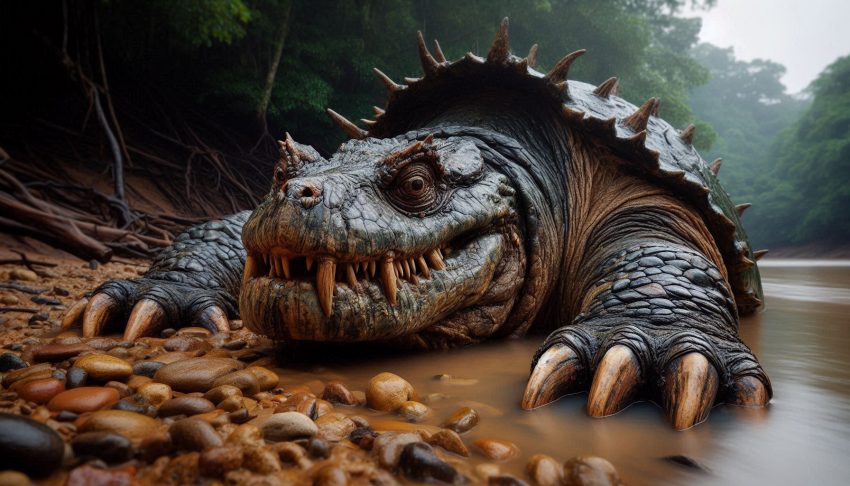
The Ogua is consistently described as a massive, hyper-aggressive creature resembling a gargantuan two-headed alligator snapping turtle. Its key physical features, as detailed across centuries of reports, include:
- Size and Weight: The beast is estimated to be nearly 20 feet long and weigh approximately 500 pounds.
- Heads: A defining feature is the presence of two monstrous, basketball-sized heads, each equipped with powerful, snapping jaws. Some accounts mention a more serpentine or lizard-like body beneath a prominent shell.
- Amphibious Nature: While primarily aquatic, dwelling in the confluence of the Ohio, Allegheny, and Monongahela rivers, the creature is infamous for leaving the water on stubby legs to hunt.
- Prey: Its diet is said to consist of large mammals, including deer, which it reportedly ambushes in shore-side paths. Terrifyingly, Native American folklore and early settler accounts warn that the Ogua is capable of seizing unwary humans from the riverbank.
The Long and Frightening History of Sightings
The legend of the Ogua is not a modern phenomenon but dates back to the earliest settlements in the region.
1. The 1745 Tragedy: The First Documented Attack
The earliest and most tragic documented sighting occurred in 1745 near the community of Hoult, West Virginia, on the Monongahela River.
Witnesses reported seeing a colossal, two-headed turtle emerge from the river, seizing a 12-year-old boy who was fishing on the bank. The creature violently pulled the child into the water, and he was never seen again. Native American tribes in the region had already warned settlers about the ferocious nature of the beast, claiming its massive jaws were capable of dragging victims to a sub-surface den to be drowned and stored for later consumption.
2. The Fort Harmer Account (Late 1700s)
A letter cited by historian Glenn Lough recounted a report from a youth stationed at Fort Harmer (Marietta, Ohio) in the late 1700s. The letter describes an “uncommon animal” that “repairs to the land in quest of its prey, which are deer.” The account details the creature ambushing deer and dragging them back to the water using its 15-foot tail. One such creature was reportedly killed by soldiers after it dragged a deer to its lair. The local Indigenous peoples named this beast
3. The 1983 Rivesville Encounter
The monster experienced a resurgence in sightings during the 1980s. In 1983, a local coal miner named John Edward White was night-fishing for channel catfish in Rivesville, West Virginia.
The water suddenly began to churn violently, and White watched in horror as a huge, serpentine form and a monstrous, basketball-sized head rose from the depths just yards away. The creature quickly sank back beneath the surface, but other fishermen reported similar encounters in the same area later that year, adding to the lore of the Rivesville River Monster.
4. The Modern Day Sightings (2003 & 2019)
Sightings continued into the 21st century, often focusing on the creature’s massive size:
- 2003 (Pittsburgh, PA): A fisherman near Pittsburgh managed to snap a photograph of a huge creature in the water, though the image was too blurry to provide definitive proof.
- 2019 (Marion County, WV): A group of friends fishing at night spotted an enormous head break the water’s surface. When illuminated by a spotlight, they confirmed it was a truly MASSIVE alligator snapping turtle, large enough to make the local news and keep the legend alive.
Theories: What is the Ogua?
With a history that spans over 275 years, researchers have offered several theories to explain the sightings:
- Prehistoric Survivor: Given the vast, deep river system, some believe the Ogua could be a surviving lineage of a prehistoric giant turtle or other unclassified aquatic reptile.
- Oversized Snapping Turtle: This is the most popular biological theory. While ordinary alligator snapping turtles are large, an abnormally aged or mutant turtle could reach the incredible size described in later sightings, fitting the shell and snapping jaw descriptions.
- Rogue Alligator: Another theory suggests the legends may have originated from sightings of a rogue American alligator that traveled up the Mississippi and Ohio Rivers and into the Monongahela. This would account for the aggressive hunting behavior on land and the drag marks left by a powerful, thick tail.
The Ogua in Fallout 76
The legend of the Ogua has been immortalized in the popular video game Fallout 76, set in a post-apocalyptic West Virginia. The game features the Ogua as a true-to-legend, massive, two-headed turtle cryptid, often encountered in river zones and even featured as a boss in seasonal events like the Fasnacht Parade. Its inclusion has brought this fascinating piece of Appalachian folklore to a global audience of gamers, solidifying its place among famous West Virginia cryptids like the Mothman and the Flatwoods Monster.
Loved the terrifying history of the Ogua? Its home in West Virginia and Pennsylvania is a hotspot for cryptids, from the Mothman to the Flatwoods Monster.
👁️ Think this was disturbing?
The Ogua is only one of many creatures documented in our Appalachian Cryptids by State series — featuring eyewitness encounters from across the region.
👉 Watch the Appalachian Cryptids by State playlist on YouTube
🔗 https://www.youtube.com/playlist?list=PLceiOgPsmGGPOFfJfp5eiVL8hmQ9mtSl6
Cryptidz Fandom: https://cryptidz.fandom.com/wiki/Ogua